StageBox Stage Timer
TL;DR: To solve the "Cloud-Fail" risk in live production, I built an offline-resilient synchronization system using Go, WebSockets, and Raspberry Pi. I leveraged Go’s concurrency (Goroutines) to deliver sub-millisecond timing and cue-light orchestration across a local mesh network, ensuring zero-latency reliability in high-stakes stage environments.
Introduction
StageBox is an offline-resilient hardware and software ecosystem designed for high-stakes professional live production. Built to solve the "Cloud-Fail" problem in touring and broadcast, StageBox provides sub-millisecond synchronization for timers, cue lights, and pedals without requiring an internet connection. It bridges the gap between the reliability of legacy industrial hardware and the intuitive UX of modern SaaS.
Design Approach
Zero-Trust Connectivity: Engineered with an "Offline-First" philosophy. The system creates its own local mesh, ensuring the show goes on even if the venue's Wi-Fi or backhaul fails.
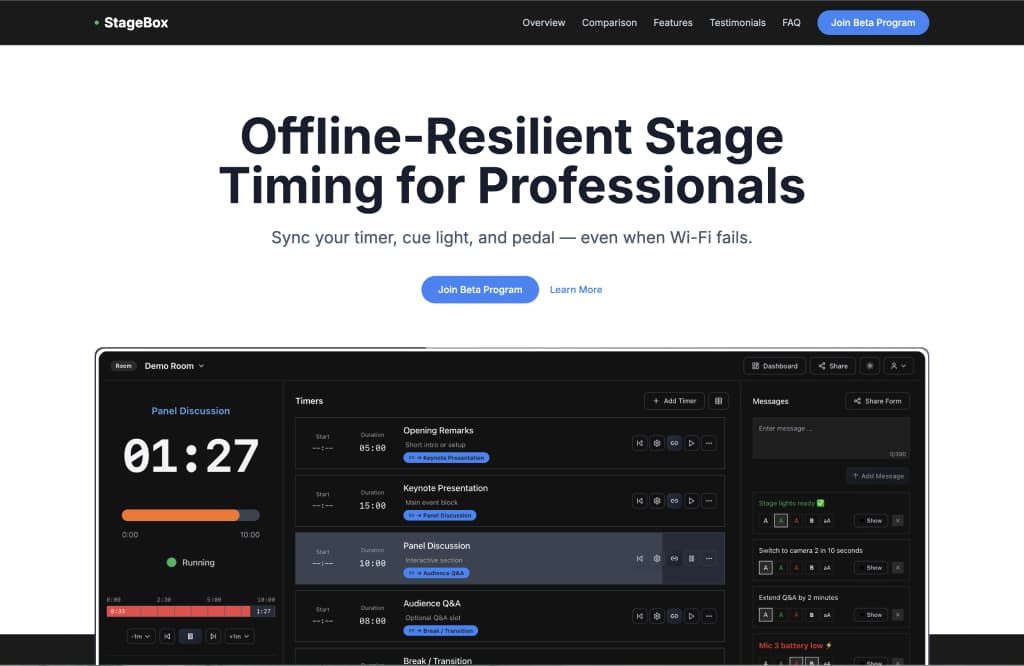
Cognitive Load Reduction: Designed for high-stress backstage environments. The UI uses high-contrast "glanceable" typography and color-coded status states (Ready/Live/Warning) inspired by aviation cockpits.
Modular Hardware Ergonomics: The physical form factor (Raspberry Pi-based) was optimized for portability, powered by a single 5V source to fit into any technician's "peli-case" or fly-pack.
Technical Stack
Infrastructure: Raspberry Pi & Industrial Routers acting as a local edge server and dedicated DHCP gateway.
Real-time Sync: WebSockets & mDNS for zero-configuration, peer-to-peer discovery and sub-millisecond latency.
Frontend: React & Tailwind CSS for a responsive, high-performance control interface accessible via any mobile browser.
Backend: Backend: Go (Golang) for the core orchestration engine. Chosen for its native support for concurrency and its ability to compile into a single, static binary for easy deployment on ARM-based edge hardware.
Concurrency Model: Leveraged Goroutines and Channels to manage simultaneous event streams (timers, cue signals, and device heartbeats) with minimal overhead.
Key Features
Operational Resilience: 100% functional without internet; eliminates "Cloud Jitter" and external latency.
Zero-Config Networking: Technicians connect via a simple QR code or local URL; no IT department or complex subnet masking required.
Hardware-Software Bridge: Integrated support for physical inputs (foot pedals) and outputs (DMX/Visual Cue Lights).
Immutable Logging: Captures local "Show Logs" for post-event technical debriefs and performance audits.
